Digital Object Identifiers
A Digital Object Identifier (DOI) is a code used to uniquely identify content of various types. DOIs enable easy online access to research data for discovery, attribution, and reuse, and enable accurate data citation and other metrics. DOIs are a persistent identifier, and as such carry expectations of curation, persistent access, and rich metadata.
There is a system and practices associated with DOI usage, for “persistent and actionable identification and interoperable exchange of managed information on digital networks” (https://support.datacite.org/docs/doi-basics).
DOIs are intended to be “resolvable,” usually to information about the object to which the DOI refers—including information about where the object can be found. For a dataset, that would be a dataset landing page providing information about the dataset like where it can be accessed. The DOI should not point to the dataset itself. The DOI remains fixed over the lifetime of the object, whereas its location and metadata may change. When the location changes, the publisher of the object is responsible for updating the metadata for the DOI to the new locations.
The developer and administrator of the DOI system is the International DOI Foundation (IDF) which introduced DOIs in 2000. Organizations that meet the contractual obligations of the DOI system and that are willing to pay to become a member (such as DataCite, see below) can assign DOIs.
The DOI system is implemented through a federation of registration agencies coordinated by the IDF. See https://www.doi.org/, and particularly https://www.doi.org/hb.html, the DOI Handbook, for details.
Purpose of DOIs
Funding agencies and publishers increasingly recognize that datasets and scientific software are valuable research outputs that should be openly available, identifiable, and citable—often through DOIs.
At LASP, digital objects worthy of identification include datasets and associated outputs (e.g., documentation, papers, workflows, algorithms, software, etc.).
DOI registries
To enable accessibility, a DOI needs to reside in a registry where it can be resolved. The registry collects and provides high level information, assigns DOIs, and links to references.
DataCite is a not-for-profit, global initiative to “help the research community locate, identify, and cite research data with confidence,” through DOI minting and registration. It is the leading global provider of DOIs for datasets. From their website:
By working closely with data centres to assign DOIs to datasets and other research objects, we are developing a robust infrastructure that supports simple and effective methods of data citation, discovery, and access. Citable data become legitimate contributions to scholarly communication, paving the way for new metrics and publication models that recognize and reward data sharing.
CU Libraries are now a member of DataCite. Through this membership, LASP can mint and register DOIs for datasets housed in our repositories, enabling data to be persistently identified, accessed, and cited.
Crossref is another registry that is often mentioned in Earth and space science contexts. It’s a not-for-profit association of ~2000 voting member publishers who represent 4300 societies and publishers. It exists to facilitate the links between distributed content hosted at other sites, and uses DOIs to do so.
Zenodo is a free repository developed by CERN and operated by OpenAIRE. It is a general-purpose repository that allows researchers to deposit datasets, research software, reports, and any other research-related digital artifacts. Zenodo assigns DOIs to the deposited content, making it citable and discoverable. See citing software for more on using Zenodo to cite software.
ORCiDs are like DOIs but provide persistent digital object identifiers for people.
DOI Format
When a LASP researcher needs a DOI, they will provide some information and receive a DOI back. They will never actually create a DOI. Nevertheless, it is worth understanding the form of a DOI and the goals behind its format.
DataCite goals for DOIs include enabling robots and crawlers to recognize DataCite DOIs as URLs, making them easy to cut and paste, and helping users recognize that DOIs are both a persistent link and a persistent identifier.
This is a DOI:
https://doi.org/10.5281/ZENODO.31780 A DOI name consists of three parts:
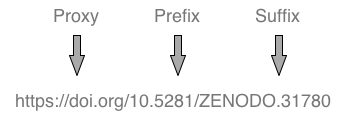
The proxy is an HTTP URL. DataCite recommends that all DOIs are permanent URLs. (Using the old DOI protocol, e.g. doi:/10.5281/ZENODO.31780 is NOT recommended.)
A DOI prefix always starts with “10.” and continues with a number. This number defines a globally unique namespace. (The scope of “global” depends on the organization managing multiple repositories.) Prefixes should not have semantic meaning. Adding meaning to the identifier is risky because “despite besting intentions, all names can change over time” DataCite DOI Basics.
The suffix for a DOI can be almost any string. Here is where information provided in an input form may be integrated into the DOI.
Note that DOI names are not case-sensitive, while URLs are case-sensitive: https://support.datacite.org/docs/datacite-doi-display-guidelines.
Useful Links
Acronyms
DOI = Digital Object Identifier
IDF = International DOI Foundation
ORCID = Open Researcher and Contributor ID
Credit: Content taken from a Confluence guide written by Anne Wilson and Shawn Polson.