Licensing
Licenses provide legally binding guidelines for the use and distribution of software and data. Licenses can be proprietary or free and open source.
Purpose for this guideline
In Data Systems, many of our code repositories are open source. An open source license gives others explicit permission to use any part of the code legally. This guide provides options for choosing the right license for your project.
Options for this guideline
Software Licenses
To avoid copyright concerns, it is recommended that:
Any software created by LASP is properly licensed to provide sufficient guidance on their usage
Any software used by LASP are licensed and used accordingly to protect against potential legal action from the owner of that intellectual property
The following table is taken from The Turing Way and shows the different categories of licenses available and the types of licenses that support their respective requirements.
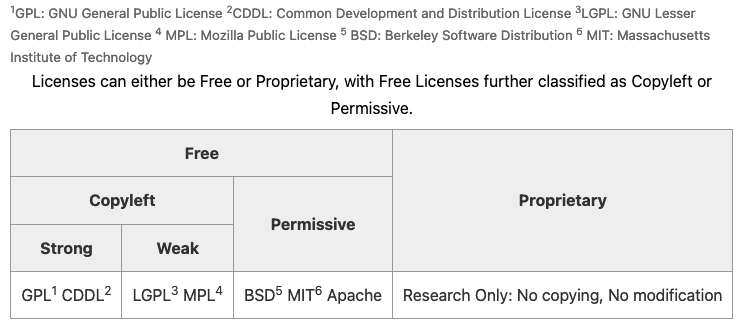
Free Licenses are classified as Copyleft or Permissive. Copyleft licenses (GPL-style) say that all derivative works must preserve the same rights as the original work. So, if it is an open-source program currently, you can NOT use that code in your closed-source program. Because of this, many people don’t consider this as “open” as the more permissive licenses that would allow someone else to use their code in a commercial closed-source product.
In general, choose a permissive license for your project in Data Systems.
Some fairly common options:
BSD-3 - Commonly used in the Python scientific community
MIT - Short and sweet, very similar to BSD-3
Apache-2 - Commonly used in the Java/Scala communities
Some examples from groups at LASP:
NOTE: There is a NASA Open Source License: https://opensource.gsfc.nasa.gov/nosa.php; However, it DOES NOT satisfy the Free Software Foundation’s definition of open source.
Data Licenses
A creative commons license can be used to restrict who can use data and how they use it.
Creative Commons: https://creativecommons.org/choose/
Data rights qualifiers
BY – Credit must be given to you, the creator.
NC – Only noncommercial use of your work is permitted.
ND – No derivatives or adaptations of your work are permitted.
SA – Adaptations must be shared under the same terms.
You can mix and match the qualifiers on the data rights depending on what limitations you want to enact on the data you’re distributing/producing.
CC0 1.0 - dedicate your work to the public domain, no copyright
CC BY 4.0 - Anyone can use the data/work, even for commercial purposes, but credit must be given to you
CC BY-NC 4.0 – Anyone can use the data/work, but NOT for commercial purposes (i.e. others can’t use your work to sell their software or product)
CC BY-NC-ND 4.0 – Anyone can use the data/work, but NOT for commercial purposes and NO derivate works (adaptations).
CC BY-NC-SA 4.0 – Anyone can use the data/work, but NOT for commercial purposes and the work must be shared alike (SA), meaning it must have the same terms of use.
How to apply this guideline
Software Licensing Guidelines
CU Venture Partners (CU lawyers) recommend using BSD-3 license.
Make sure that you put the license file in the root directory and call it
LICENSEorLICENSE.mdso that the code repository (GitHub, GitLab, Bitbucket) can immediately identify what license your code is released under and let contributors know.Fill out the copyright, noting that it is NOT LASP, but Regents of CU. Copyright (c) YYYY, Regents of the University of Colorado
Data Licensing Guidelines
Public data from NASA missions default to the CC0 1.0 license, unless otherwise marked.
NASA guidance specifies that all data from NASA sponsored missions are to be reusable with a clear, open, and accessible data license. It does not enforce a specific license, however.
CC0 1.0 is the license most widely used for public data within LASP.
CC-BY 4.0 is also used for public data in some missions (for example, TSIS-1); this keeps the data open but asks the user to attribute the data source.
For more information on licensing Earth data, please reference the EarthData Data Use and Citation Guide
For Heliophysics data, please reference the Heliophysics Data Management Handbook.