Data Stewardship at LASP
LASP has a hard-earned, world-class reputation for creating valuable, high-quality datasets. These datasets, often paid for by U.S. taxpayers, are our legacy.
Purpose
The world of science is rapidly evolving, particularly in how research data is managed and how science is conducted. Expectations from government agencies, OSTP, and publishers around open and accessible research data have significant implications for:
Scientific conduct and integrity
Funding for science
Scientific publication
Attribution and rewards
By following best practices in data stewardship, LASP ensures its datasets remain accessible, reproducible, and valuable for the scientific community.
Key principles
Several key principles guide data stewardship and open science at LASP:
Open Data
Funding agencies now expect data—and, in some cases, the software that created it—to be made available beyond the project that produced it. Agencies such as USGS, NASA, NOAA, and NSF require data management plans in proposals, and funded projects must meet these responsibilities. This generally includes:
Making data and metadata publicly accessible.
Ensuring machine-readability for automated tools.
Organizations such as ESIP, RDA, ESDSWG, and CODATA work to enhance data management and sharing nationally and internationally.
Enabling a Science Ecosystem
Scientific artifacts should be preserved as a lasting world heritage. As scientific data grows in complexity and scale, interoperable tools, standards, and conventions play a crucial role in simplifying and automating data processing, analysis, and metadata collection. Data that is FAIR—findable, accessible, interoperable, and reusable—is essential to supporting these efforts.
Reproducibility
A key issue in modern science is the reproducibility crisis, where peer reviewers find it difficult to replicate results from many publications. While complete reproducibility may not always be feasible, best practices in data management ensure:
Experiments can be rerun, validated, or verified.
Data and documentation are identifiable and machine-readable.
Automated tools can process and analyze data.
Workflow and notebook tools enable shareable, reproducible workflows.
For more on improving reproducibility in Earth science research, see: EOS article.
Return on Investment
Good data management maximizes the impact of a dataset, allowing for wider use now and in the future. This benefits both science and society by increasing the return on investment in data collection and analysis.
Scientific Publication
Publishing is evolving, with journals increasingly requiring:
Data contributions alongside publications.
Linking publications with datasets and executable code.
Organizations like FORCE11 advocate for semantically enhanced, media-rich digital publishing, which is more powerful than traditional print media.
Attribution for Datasets and Science Software
Funding agencies and publishers are promoting cultural shifts in how datasets and software are credited. High-quality datasets and software are now recognized as independent scientific contributions.
Since datasets are often generated by software, proper software management is a critical component of data stewardship. The Software Sustainability Institute supports sustainable research software.
How to apply these principles
To meet the expectations outlined above:
Develop a Data Management Plan (DMP)
Address how data will be stored, accessed, and shared.
Align with agency requirements (e.g., NASA, NSF).
Ensure Open Access
Make datasets and metadata publicly available.
Use machine-readable formats when possible.
Use Standardized Metadata and Formats
Follow best practices for documentation and accessibility.
Use tools that support automated metadata generation.
Maintain Provenance and Reproducibility
Record data lineage, processing steps, and software versions.
Use reproducible workflows and notebook tools.
Publish Data Alongside Research
Link datasets with publications.
Provide clear attribution for datasets and software.
Engage with Data Stewardship Communities
Participate in organizations like ESIP, RDA, and CODATA.
Follow emerging best practices in open science.
Assessing data management maturity
To assess data stewardship maturity, consider the following rubrics:
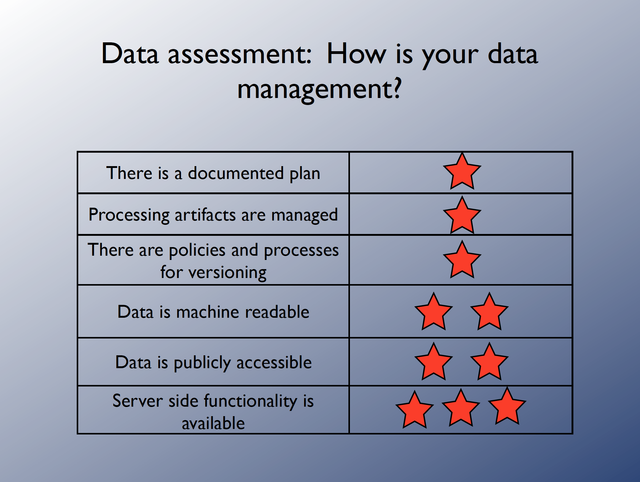
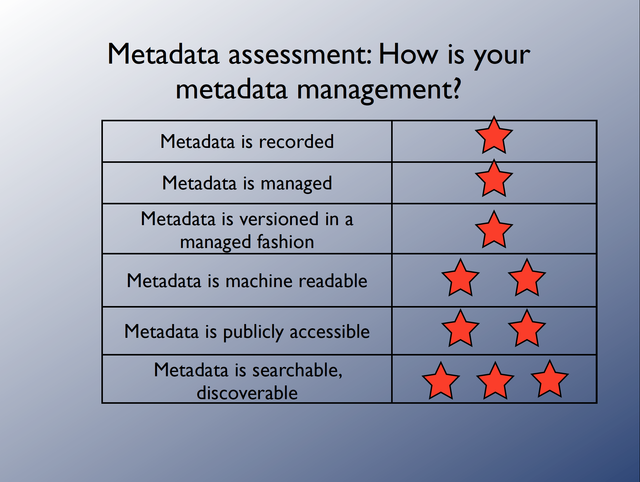
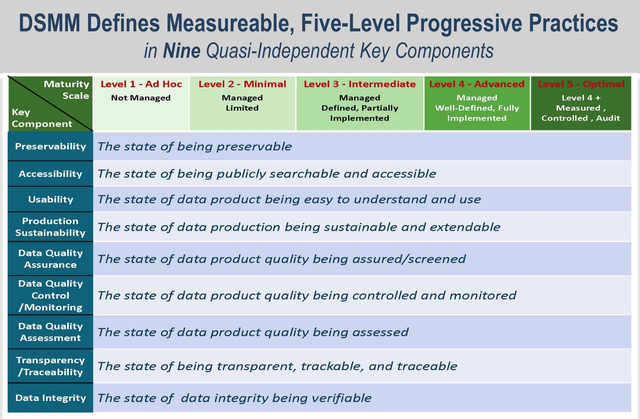
Efforts to define levels of data stewardship maturity have produced useful rubrics that have been shown to help repositories and projects evaluate and improve their data stewardship efforts. In particular, and similar to the CMMI that was developed for process improvement, a maturity matrix for data stewardship was developed. A high-level view of that matrix is presented here. Note that Level 3 was determined to be the recommended level of attainment for operational digital products stewarded by national data centers.
Useful Links
Acronyms
AGU = American Geophysical Union
CODATA = Committee on Data for Science and Technology
DMP = Data Management Plan
ESDSWG = Earth Science Data Systems Working Group
ESIP = Earth Science Information Partners
FAIR = Findable, Accessible, Interoperable, and Reusable
FORCE11 = Future of Research Communication and e-Scholarship
NASA = National Aeronautics and Space Administration
NOAA = National Oceanic and Atmospheric Administration
NSF = National Science Foundation
OSTP = Office of Science and Technology Policy
RDA = Research Data Alliance
USGS = United States Geological Survey
Credit: Content adapted from a Confluence guide written by Anne Wilson and Shawn Polson.